
Borough of Churches: A Jane's Walk Through Brooklyn Heights' Historic Churches

This past weekend I led a Jane's Walk through Brooklyn Heights, one of New York City's most architecturally rich neighborhoods. Our focus: the extraordinary collection of 19th-century churches that line its leafy streets. Brooklyn Heights was home to some of the most ambitious and celebrated church architects of the era — Minard Lafever, Richard Upjohn, James Renwick Jr., and Patrick C. Keely all left their mark here. What follows are notes on each stop along the way.
1. St. Ann & the Holy Trinity — Clinton Street at Montague Street

Religion: Episcopal
Parish Founded: 1778 (as the first Episcopal congregation in Kings County)
Building Constructed: 1844–1847
Architect: Minard Lafever
We began at the crown jewel of the walk. Standing at the corner of Clinton and Montague Streets, St. Ann & the Holy Trinity is one of the finest Gothic Revival buildings in the United States, and by many accounts the masterpiece of its architect, Minard Lafever.
The church was commissioned by Edgar John Bartow, a Brooklyn paper manufacturer who wanted to build what he described as a magnificent, rent-free house of worship for the people of Brooklyn — a rival to Trinity Church on Wall Street in Manhattan. Bartow purchased eight lots at the highest point of Brooklyn Heights from the nearby estate of Hezekiah B. Pierrepont (his wife's family) and hired Lafever to design the church, an adjoining chapel, and a rectory. Construction began in 1844, and the doors opened in 1847. At that time, it was the largest structure in Brooklyn.

The spire — which you no longer see today — was added in 1866, designed by Patrick C. Keely (whom we'll encounter again on this walk). When completed, the tower and spire reached 295 feet, making it taller than Trinity Church in Manhattan by 15 feet and the tallest structure in either Brooklyn or New York City. It was used by ship captains in conjunction with Trinity's spire to navigate into New York Harbor. The spire was removed in 1905–1906, originally cited as being due to concerns about falling brownstone and the high cost of maintenance — though the construction of the Broadway subway line under Montague Street during that period was also a contributing factor.
The church is particularly celebrated for its stained glass windows — over 7,000 square feet of painted glass by William Jay Bolton (with his brother John Bolton), created between 1845 and 1848. These are recognized as the first complete series of figural stained glass windows made in North America, depicting the life of Christ. One of Bolton's organ loft windows is today on permanent display in the American Wing of the Metropolitan Museum of Art.
The Reverend Abram Newkirk Littlejohn, rector of Holy Trinity, was elected the first Bishop of the newly created Episcopal Diocese of Long Island in 1868, and the church served as pro-cathedral of that diocese until 1885.
In the 1950s, the church became the center of a bitter McCarthy-era dispute. Rector John Melish and his son Howard — who chaired the National Council of American-Soviet Friendship — were targeted by the church's vestry in a nationally publicized struggle. After a decade of legal battles, the Episcopal Diocese closed the church in 1957, and it stood largely empty for more than a decade.
In 1969, the congregation of nearby St. Ann's Church (the oldest Episcopal parish in Brooklyn, originally founded in 1778 in the living room of Joshua and Ann Sands) relocated here after selling its property on Livingston Street to the Packer Collegiate Institute. The merged congregation took the name St. Ann & the Holy Trinity. The church was declared a National Historic Landmark in 1987.
Restoration efforts began as early as 1979, when the nonprofit St. Ann's Center for Restoration and the Arts was established. That effort eventually stabilized major portions of the exterior, facade, nave roof, and many of the Bolton windows before relocating to DUMBO in 2000 as St. Ann's Warehouse. A state preservation grant followed in 1997, and the church has since raised over $4 million toward ongoing restoration. As you can see from the scaffolding and weathered brownstone, there is still considerable work ahead.
About the Architect — Minard Lafever (1798–1854):
Lafever was a largely self-taught architect — trained as a carpenter — who became one of the leading figures of the Gothic Revival in America, so celebrated by contemporaries that he was called the "Sir Christopher Wren of America." His work spanned multiple revival styles. Other notable works include the First Presbyterian Church in Sag Harbor (Egyptian Revival), the Church of the Holy Apostles at Ninth Avenue and 28th Street in Manhattan (Romanesque/Italianate), Sailors' Snug Harbor in Staten Island (Greek Revival), and his final commission, the Packer Collegiate Institute right here in Brooklyn Heights (Tudor Gothic). Four of his buildings were designated National Historic Landmarks.
2. St. Ann's Church (now Packer Collegiate Institute) — Clinton Street at Livingston Street

Religion: Episcopal
Parish Founded: 1787 (originally as the Episcopal Church of Brooklyn; renamed St. Ann's in 1795)
Building Constructed: 1866–1869
Architect: James Renwick Jr. (with partner Joseph Sands, as Renwick & Sands)
Style: Venetian Gothic / Ruskinian Gothic
Just a few blocks from Holy Trinity, the building that once housed St. Ann's Church now serves as part of the Packer Collegiate Institute. The story of this congregation reaches back to the very founding of Brooklyn.
The parish traces its origins to 1778, when a group of Anglican-minded neighbors in the Village of Brooklyn began holding services in the living room of Joshua and Ann Sands during the American Revolution. The growing congregation moved in 1784 to the barn of John Middagh, one of the first settlers of Brooklyn Heights. The congregation formally organized as the Episcopal Church of Brooklyn in 1787, and took the name St. Ann's in 1795.
In 1869, when the Brooklyn Bridge's planned approach required use of the congregation's Washington Street property, the parish moved to this new building at Clinton and Livingston Streets, designed by the celebrated architect James Renwick Jr. in the Venetian (or Ruskinian) Gothic style. It is considered one of the most important High Victorian Gothic church buildings in the nation.
The congregation's most notable pastor was Rev. Abram N. Littlejohn, who served as rector before being elected the first Bishop of Long Island in 1868 (he served at the Holy Trinity building, the pro-cathedral, in that role).
In 1966, St. Ann's sold the church property to the Packer Collegiate Institute next door. The congregation then relocated four blocks away into the long-empty Holy Trinity building in 1969, becoming St. Ann & the Holy Trinity. The old St. Ann's building was converted into classrooms, with the nave now housing three floors of academic space.
About the Architect — James Renwick Jr. (1818–1895):
Renwick was one of the most prolific and celebrated American architects of the 19th century, equally at home in Gothic Revival, Romanesque, and Second Empire styles. He is perhaps best known for St. Patrick's Cathedral on Fifth Avenue (begun 1858, opened 1879), widely regarded as his masterpiece. His other famous works include Grace Church on Broadway at 10th Street in Manhattan (his first major commission, completed 1846), the Smithsonian Institution Building ("The Castle") in Washington, D.C. (1847–55), and the Corcoran Gallery of Art (now the Renwick Gallery) in Washington, D.C. (1859–1871). He also designed the Main Building of Vassar College in Poughkeepsie (1861–1865).
3. St. Charles Borromeo Church — Sidney Place at Livingston Street

Religion: Roman Catholic
Parish Founded: 1849
Building Constructed: 1869
Architect: Patrick C. Keely
Style: English Gothic / Neo-Gothic
Stepping from the Episcopal tradition to the Catholic, our next stop is the red-brick Gothic landmark at the corner of Sidney Place and Livingston Street.
St. Charles Borromeo was founded in 1849 as Brooklyn's sixth Catholic parish, four years before the Diocese of Brooklyn was even established. The original church on this site had a different history entirely: it was a former Emmanuel Protestant Episcopal Church building that was purchased by New York Archbishop John Hughes and the parish's founding pastor, Rev. Charles Constantine Pise, D.D. Father Pise was a remarkable figure — a distinguished poet, professor, and America's first Catholic novelist. He was also the only Catholic chaplain in U.S. Senate history, nominated by his friend Henry Clay. Under his leadership, the parish founded a school and established the St. Vincent de Paul Society.
In March 1868, fire destroyed the original church building. The second pastor, Rev. Francis J. Freel, acquired new land and commissioned the current building, which was completed in 1869 at a cost of $75,000–$80,000. Notably, St. Charles Borromeo is said to be Keely's 325th completed church — something of a milestone in a career of astonishing output.
The building features red Philadelphia brick, stone trim, a gabled slate roof, a 156-foot steeple topped with a statue of St. Charles Borromeo, and fourteen stained glass windows with scenes from the New Testament along the nave walls, plus a large window above the altar depicting St. Charles Borromeo himself. The choir space contains white marble, dark wood screens with back-lit stained glass panels, and Gothic ornamentation. The church also possesses a remarkable historic organ: an 1880 Odell tracker organ (Opus 178) that is the largest and perhaps last extant example of its kind in New York City.
About the Architect — Patrick C. Keely (1816–1896):
If any single architect shaped the look of Catholic America in the 19th century, it was Patrick Keely. Born in Thurles, County Tipperary, Ireland, he emigrated to Brooklyn in 1842, initially working as a carpenter. Over a career of more than 50 years, he designed nearly 600 churches and 16 cathedrals throughout the eastern United States and Canada — including every 19th-century Catholic cathedral in New England. Among his landmark works are the Cathedral of the Holy Cross in Boston, the Cathedral of Saints Peter and Paul in Providence, Rhode Island, and the Holy Name Cathedral in Chicago. He was also responsible for the spire added to St. Ann & the Holy Trinity in 1866, as we saw on our first stop. In 1884, the University of Notre Dame awarded Keely its Laetare Medal — only its second-ever recipient — for "changing the style of ecclesiastical structures and modifying architectural taste in this country."
4. Grace Church — Hicks Street at Grace Court (between Joralemon and Remsen)

Religion: Episcopal
Parish Founded: 1847
Building Constructed: 1847–1848
Architect: Richard Upjohn
Grace Church occupies one of the most picturesque corners in Brooklyn Heights, and its history is closely intertwined with the story of a congregation that simply didn't want to cross the river on Sundays.
In the early 1840s, many Brooklyn Episcopalians were making the ferry journey to Lower Manhattan each week to attend services at Grace Church on Broadway. When that congregation moved further uptown to Broadway and 10th Street, Brooklyn parishioners found the trip impractical, and began attending a local Episcopal congregation called Emmanuel Church on Sidney Place at Livingston Street. But Emmanuel couldn't accommodate the influx of new members, so a new parish was founded in 1847 — Grace Church Brooklyn Heights — with the Rev. Francis Vinton as its first rector. (That original Emmanuel Church building on Sidney Place would eventually become St. Charles Borromeo, as we just saw.) The building committee was headed by Henry Evelyn Pierrepont and Colonel Tunis Craven, who selected the site and hired the architect.
They chose Richard Upjohn, the most celebrated church architect in America at the time, best known for his recently completed Trinity Church Wall Street (1846), which had established Gothic Revival as the dominant idiom for American Episcopal churches. He designed Grace Church in the same English Gothic Revival tradition. The cornerstone was laid on June 29, 1847, and the first service was held on December 10, 1848. A Sunday school and parish school building designed by Upjohn was added next door on Grace Court in 1865.

The church's interior is a treasure trove of Victorian ecclesiastical art. During the early 20th century, the original diamond-pane windows were replaced with stained glass from leading studios of the era — including three windows by the Tiffany Glass Company, as well as works by J&R Lamb, Clayton & Bell, Franz Mayer of Munich, Cottier & Co., Maitland Armstrong, Heaton Butler and Bayne of London, and Charles Booth. The open trusswork ceiling features a unique celestial motif, and the floors are decorated with mosaics.
Grace Church School — today the oldest preschool in Brooklyn — began operating on the church's premises in the late 1920s.
The church underwent an extensive restoration from 2013 to 2014, winning multiple preservation awards including a 2015 Lucy G. Moses Preservation Award from the New York Landmarks Conservancy.
About the Architect — Richard Upjohn (1802–1878):
Born in Shaftesbury, England, and trained as a cabinetmaker, Upjohn brought Gothic Revival church architecture to the United States with a rigor and authenticity that had no precedent. His Trinity Church Wall Street (1841–1846) is considered the masterwork of the American Gothic Revival and became the model for countless Episcopal churches across the country. Upjohn co-founded the American Institute of Architects in 1857 and served as its first president for nearly 20 years. He designed dozens of churches across the country, from large commissions like St. Paul's Cathedral in Buffalo to modest rural mission churches, whose designs he published and gave away freely in his influential book Upjohn's Rural Architecture (1852). In addition to Grace Church and Trinity Church, he designed the building that is now Our Lady of Lebanon — our next stop.
5. Our Lady of Lebanon Maronite Cathedral — Henry Street at Remsen Street

Religion: Maronite Catholic (originally Congregationalist)
Building Constructed: 1844–1846 (as Church of the Pilgrims)
Maronite Parish Founded: 1903 (moved to this building: 1944)
Architect: Richard Upjohn (original); addition by Leopold Eidlitz (1869)
Style: Romanesque Revival
This is another Upjohn church — but a very different Upjohn from the Gothic Revival master we just saw at Grace Church. Here, designing for Congregationalists who were deeply suspicious of the "Catholic" associations of pointed Gothic arches, Upjohn shifted to the Romanesque Revival — round arches, fortress-like masonry walls, and restrained ornament. The result is one of the most powerful church presences in the neighborhood.
The building was constructed in 1844–1846 as the Church of the Pilgrims — the first Congregational church in Brooklyn and one of the first Romanesque Revival ecclesiastical buildings in America. The cornerstone was laid on December 22, 1844, and the first service held on May 12, 1846. The heavy walls, two to four feet thick, are faced with tan-gray sienite quarried locally near the East River. An addition designed by Leopold Eidlitz in 1869 added 450 seats and additional meeting rooms.
By the early 20th century, the Brooklyn Heights population had shifted and both the Church of the Pilgrims and nearby Plymouth Church had declining memberships. In 1934, they merged to form the Plymouth Church of the Pilgrims, housed in the Plymouth building on Orange Street. The Pilgrims congregation took their original Tiffany stained glass windows with them, where they remain today in Hillis Hall at Plymouth Church.
The now-vacant building was purchased in 1943 for $70,000 by Father Mansour Stephen, whose uncle Father Khairallah Stephen had founded the Lebanese Maronite Catholic community in New York in 1900. The new Our Lady of Lebanon was dedicated on November 26, 1944, and in 1977, when the Eparchy of St. Maron was relocated from Detroit to Brooklyn, it was designated a cathedral.

The building's most celebrated feature today may be its doors — the arched bronze doors on Henry Street are repurposed dining hall doors from the SS Normandie, the legendary French ocean liner that capsized at its Manhattan pier in 1942 after being accidentally set on fire during conversion to a troop ship. The doors were salvaged from the wreck and resized to fit the Romanesque arches of the church.
New stained glass windows were commissioned for the church: Swiss artist Jean Crotti created windows using the gemmaux method in his Paris workshop in 1953, and Lebanese artist Sabiha Douaihy created additional windows in the late 1950s. Other notable furnishings include marble and onyx flooring from the French and Lebanese Pavilions of the 1939 New York World's Fair.
6. Plymouth Church — Orange Street between Henry and Hicks Streets

Religion: Congregational
Parish Founded: 1847
Present Building Constructed: 1849–1850
Architect: Joseph C. Wells
Style: Italianate / Auditorium-style
If any church on this walk changed the course of American history, it is this one. Plymouth Church was founded in 1847 by 21 individuals — mostly transplanted New Englanders — and they immediately called as their first pastor a young minister named Henry Ward Beecher.
Beecher would go on to become the most famous preacher in 19th-century America. His passionate, theatrical sermons against slavery filled the pews to overflowing — reportedly drawing 2,800 worshippers on a typical Sunday, with folding seats for thousands more on special occasions. Visitors came from Manhattan by ferry just to hear him preach. Among his regular guests at the pulpit were Frederick Douglass, Sojourner Truth, and William Lloyd Garrison. His sister Harriet Beecher Stowe was a member of the congregation, and her Uncle Tom's Cabin was deeply influenced by stories she heard and people she met here. President Abraham Lincoln attended services at Plymouth Church in February 1860, a day before his celebrated Cooper Union address.
Plymouth Church was a major stop on the Underground Railroad, its basement used to conceal enslaved people fleeing north. It was known locally as "Brooklyn's Grand Central Depot." Beecher himself held theatrical mock slave auctions from the pulpit to raise funds to purchase the freedom of enslaved individuals — in the most famous case, collecting $900 from the congregation to free an enslaved child named Sally Maria Diggs.
The original Plymouth Church building on Cranberry Street was damaged by fire in 1849. J.C. Wells, an English architect and co-founder of the American Institute of Architects, designed the current red-brick sanctuary on Orange Street, completed in 1850. The design was heavily influenced by Beecher himself, who wanted a preaching auditorium — no center aisle, excellent acoustics, cast iron columns supporting open galleries, and sightlines designed for maximum visibility. It resembles a theater more than a traditional church, and was enormously influential on American Protestant church design.

The church is also home to remarkable stained glass: the Frederick Lamb windows were made specifically for Plymouth, and when the Church of the Pilgrims merged with Plymouth in 1934, they brought their Louis Comfort Tiffany windows with them, which are now displayed in Hillis Hall behind the main sanctuary.
Beecher served until his death in 1887. He was succeeded by Lyman Abbott (1887–1899) and Newell Dwight Hillis (1899–1924), who oversaw a major expansion of the physical campus including the church house and arcade. A statue of Beecher by sculptor Gutzon Borglum — better known as the creator of Mount Rushmore — stands in the church garden between the sanctuary and the church house.
The church was designated a National Historic Landmark in 1966.
7. Danish Seamen's Church (Den Danske Sømandskirke) — 102 Willow Street (between Clark and Pierrepont)
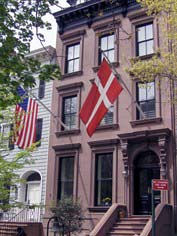
Religion: Lutheran (Danish)
Founded: 1878 (moved to this building: 1957)
Building Constructed: c. 1860s
Architectural Style: Italianate brownstone
We ended our walk at what is, architecturally speaking, one of the most understated buildings on the tour — a handsome five-story Italianate brownstone distinguished mainly by the cast iron ship's bell sitting in the front yard. But this building holds a fascinating and often-overlooked piece of Brooklyn history.
In the 19th and early 20th centuries, Brooklyn was one of the busiest ports in the world, and the waterfront communities along the Brooklyn Heights escarpment were home to a substantial Scandinavian population — Danish, Norwegian, Swedish, and Finnish sailors and dockworkers who worked the ships docking at Columbia and Furman Streets below.
The Danish Seamen's Church (Den Danske Sømandskirke) was founded in 1878 by the Danish minister Rev. Rasmus Andersen, who would remain its pastor for more than four decades (1883–1924). In an apocryphal but charming detail, only two people attended the very first service on July 10, 1878 — a local tailor and the celebrated Danish-American social reformer and photographer Jacob Riis. In 1886, Andersen established Our Saviour's Church on 9th Street in Gowanus to serve the community, and the institution evolved from there.
The church moved to this Willow Street building in 1957, purchasing it to serve as both a house of worship and a community center for New York's Danish community. The building itself dates to the 1860s and is considered one of the finest surviving Italianate brownstones in Brooklyn Heights, with its wide brownstone stoop, hooded windows, and acanthus leaf brackets flanking the door.
Services are conducted here in Danish — making it the only church in North or South America to hold services in the Danish language. Today the congregation is composed largely of Danish expatriates and professionals living in the New York area, and the church continues its dual mission of spiritual community and cultural anchor. Each November, the church holds its beloved Julemarked (Christmas Market) in partnership with Plymouth Church, a beloved neighborhood tradition featuring Danish food, design, gløgg, and æbleskiver.
______________________________________________________________________________
Brooklyn Heights was designated New York City's first historic district in 1965, and walking its streets it's easy to understand why. In a neighborhood of barely half a square mile, you can trace the full arc of 19th-century American ecclesiastical architecture — from Lafever's Gothic pinnacle to Upjohn's Romanesque fortress to Renwick's High Victorian drama to the humble brownstone that sheltered a congregation of sailors far from home. Each of these buildings is still standing, still active, and still telling stories. I hope you'll come back on your own and spend some time with them.
______________________________________________________________________________

Comments