
Washington’s Retreat | Part 2 of 5: The Fort Built to Save New York

After Washington forces the British out of Boston in March 1776, he immediately has to start thinking about where they’re going to strike next. There were several possibilities, but the most obvious target was New York. The city sat at the mouth of the Hudson River, had one of the best harbors in North America, and controlling it could give the British a base from which to potentially cut New England off from the rest of the colonies.

So on April 13, 1776, Washington arrives in New York and begins preparing the city for an attack.
From Lower Manhattan, Washington could look across the East River and see the high bluffs rising above the Brooklyn waterfront. Whoever controlled those heights would have a commanding position over the river, the harbor, and the approaches to New York. Washington knew he couldn’t afford to simply hand that ground over to the British, so troops were sent across the river to begin fortifying Brooklyn.
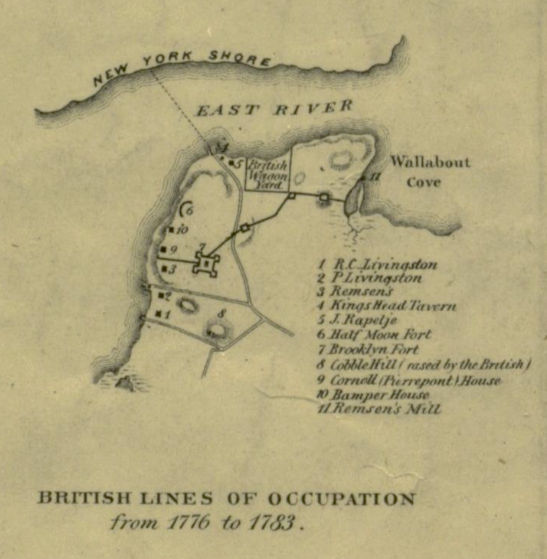
One of the defenses they constructed was Fort Half-Moon, located near what is today the northern end of Brooklyn Heights.
The name came from the fort’s shape. Its defenses curved into a crescent, or half-moon, overlooking the East River. But when you hear the word fort, don’t picture a massive stone castle with towering walls. Revolutionary War fortifications like this were often much simpler. Fort Half-Moon was primarily an earthwork: soldiers dug trenches, piled up dirt to create protective walls, and positioned cannons behind them.

There were plans to make the position much more substantial. A larger fortification known as “The Congress” was proposed for the landward side of Fort Half-Moon, which would have provided additional protection from an attack coming from Brooklyn. Those plans, however, were never fully realized.
When the Battle of Brooklyn erupted on August 27, Fort Half-Moon itself wouldn't become the scene of the intense fighting taking place farther south and east. The American army was eventually pushed back into its defensive lines around Brooklyn Heights, and two nights later Washington secretly evacuated his remaining troops across the East River to Manhattan.
Once the British occupied Brooklyn, Fort Half-Moon lost much of its original purpose. The British constructed their own fortification just a few blocks away, and Fort Half-Moon became more of a secondary defensive position.
Today, a plague commemorating the site is all that’s left. But in the spring and summer of 1776, this bluff overlooking the East River was part of Washington’s attempt to turn Brooklyn Heights into a fortified barrier protecting New York City, defenses that would soon be tested in the largest battle of the American Revolution up to that point.
What Washington saw from our next stop would lead him to make one of the most important decisions of the entire war. Come back tomorrow for Cobble Hill Fort.


Comments