
The Five Families That Built Brooklyn Heights

Updated: Sep 2
Today, Brooklyn Heights is celebrated for its charming brownstones, tree-lined streets, and stunning views of Lower Manhattan. However, long before it became one of New York City’s most sought-after neighborhoods, it was a landscape of farmland, estates, ferry landings, and rolling hills owned by influential families.

These families shaped the neighborhood through their wealth, political influence, and early development efforts. Together, they transformed Brooklyn Heights from a rural Dutch settlement into what many consider New York’s first suburb.
Here are five of the most significant families in Brooklyn Heights history.
1. The Livingston Family: Brooklyn Heights’ Revolutionary Powerhouse
Few names loom larger over early Brooklyn Heights than the Livingstons.

The Livingston family was part of New York’s colonial elite, comprising wealthy landowners, merchants, politicians, and military leaders whose influence stretched from Manhattan to the Hudson Valley. Philip Livingston, a signer of the Declaration of Independence, owned a sprawling estate in Brooklyn Heights that served as both a country retreat and a political hub.
After the Battle of Long Island in 1776, George Washington and his officers reportedly met at Livingston’s Brooklyn Heights home. They debated whether the Continental Army should retreat from Long Island. That overnight evacuation across the East River became one of the most pivotal moments of the American Revolution.
The British later occupied the estate, turning the house into a naval hospital during the Revolutionary War.

However, the family’s impact extended far beyond one house. The Livingstons were involved in some of the most significant political developments in early American history. Philip Livingston signed the Declaration of Independence. His cousin, Robert R. Livingston, administered George Washington’s presidential oath of office and helped negotiate the Louisiana Purchase.
Even today, traces of the family remain embedded in the neighborhood. Garden Place sits where the Livingston gardens once flourished, preserving the memory of what was once one of the grandest estates in Brooklyn Heights.
2. The Remsen Family: Farmers, Ferry Operators, and Revolutionaries
Before Brooklyn Heights became a neighborhood of brownstones, much of it belonged to the Remsen family. The Remsens were descendants of some of Brooklyn’s earliest Dutch settlers and owned vast stretches of farmland across what are now Brooklyn Heights, Cobble Hill, and Boerum Hill.
Their influence extended beyond land ownership. The family became deeply involved in the legal and political battles that shaped early Brooklyn, particularly the fight over ferry rights along the East River.
In the 1700s, Brooklyn and New York City were embroiled in a long-running dispute over control of ferries and waterfront property. Hendrick Remsen emerged as a key figure in that battle when he successfully defended Brooklyn’s right to operate ferries independently from Manhattan interests.

The family also played a crucial role during the American Revolution. Colonel Jeremiah Remsen fought alongside Washington during the Battle of Long Island and helped cover the Continental Army’s retreat to Manhattan. Without that escape, the Revolution might have ended in Brooklyn.
As Brooklyn urbanized in the early 1800s, the Remsen farms gradually transformed into streets and residential lots. Many of the roads and property lines in modern Brooklyn Heights trace back to former Remsen landholdings. Even today, the family’s legacy survives through places like the Remsen Family Cemetery in Queens and streets, playgrounds, and historical references scattered throughout Brooklyn.
3. The Pierrepont Family: The Visionaries Behind “New York’s First Suburb”

If the Remsens represented old rural Brooklyn, the Pierreponts symbolized its future. No individual shaped modern Brooklyn Heights more than Hezekiah Beers Pierrepont. In the early 1800s, he recognized something most New Yorkers did not yet understand: with reliable ferry service, wealthy Manhattan residents could live across the river and commute into the city.
That idea helped transform Brooklyn Heights into America’s earliest commuter suburb. Pierrepont didn’t just develop land; he actively marketed Brooklyn Heights as a healthier, quieter, and more refined alternative to crowded Manhattan. One surviving advertisement described the neighborhood as the “nearest country retreat” from New York City, highlighting its elevated breezes, scenic waterfront views, and easy ferry access to Lower Manhattan. The ad even promoted the idea of forming a “select neighborhood and circle of society,” revealing just how intentionally Pierrepont envisioned the Heights as an exclusive residential enclave.
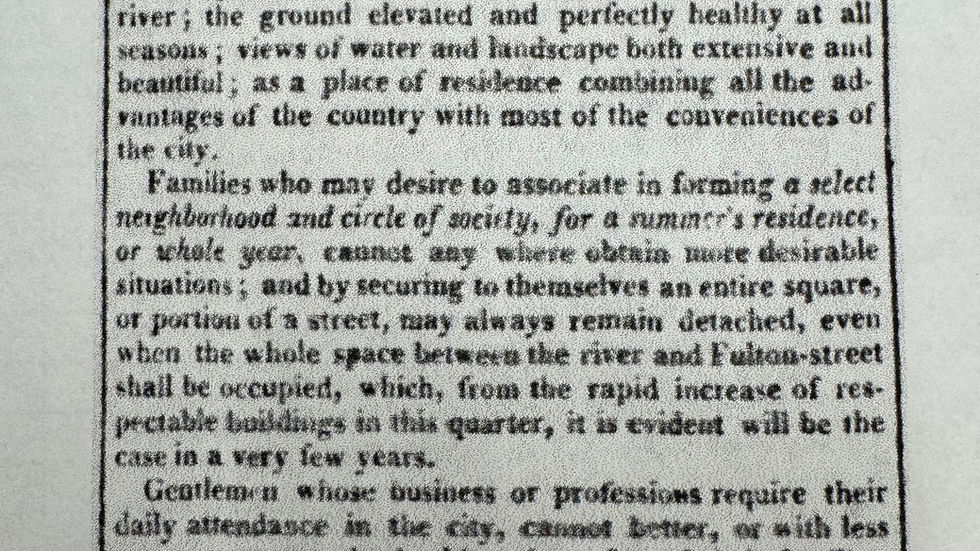
The advertisement also emphasized spacious streets, carefully planned lots, and the ability for wealthy families to remain somewhat detached from the congestion of the growing city. In many ways, it reads like an early version of suburban real estate marketing, decades before the modern suburb even existed.
Pierrepont envisioned an orderly, elegant neighborhood with wide setbacks, large homes, and carefully planned streets. His developments catered to upper-class Manhattan families seeking cleaner air, quieter streets, and views of New York Harbor.
In many ways, Pierrepont introduced the concept of suburban living to New York City long before the arrival of rail suburbs or automobiles. His influence can still be seen south of Clark Street, where blocks feel noticeably grander and more uniform. That wasn’t accidental; it was part of Pierrepont’s carefully controlled vision for the neighborhood.
Pierrepont also championed major infrastructure projects, including expanded ferry connections that made Brooklyn Heights practical for commuters. Without the Pierreponts, Brooklyn Heights likely would not have evolved into the neighborhood we recognize today.
4. The Hicks Family: The Builders of Working Brooklyn Heights
While Pierrepont was designing a neighborhood for the wealthy, the Hicks family envisioned something different. John and Jacob Hicks were major landowners whose farms covered much of northern Brooklyn Heights. Unlike Pierrepont, the Hicks brothers focused on creating smaller, more affordable lots aimed at tradesmen, artisans, and working families.

This led to one of the most important planning compromises in Brooklyn Heights history. After disputes over street layouts and lot sizes, a deal was reached: south of Clark Street would largely follow Pierrepont’s grand suburban vision, while north of Clark Street would reflect the Hicks brothers’ denser and more practical approach.
When you walk the neighborhood today, you can still feel that difference. The Hicks family also became tied to one of Brooklyn Heights’ most beloved mysteries: the Fruit Streets.
Hicks Street itself remains one of the major north-south streets through Brooklyn Heights, a lasting reminder of the family’s influence.
5. The Middagh Family: The Dutch Roots of Brooklyn Heights
Long before brownstones or ferry commuters arrived, Brooklyn Heights was part of a Dutch colonial world. Few families represent that era better than the Middaghs. The Middagh family was among Brooklyn’s earliest Dutch settlers and owned significant land in the northern portion of Brooklyn Heights. Middagh Street still carries their name today.
The family also played an important role in the early religious history of Brooklyn Heights. During the American Revolution, Anglican-minded residents began holding services in the home of Joshua and Ann Sands. As the congregation grew, they moved in 1784 to the barn of John Middagh, one of the earliest settlers in Brooklyn Heights. That congregation would later formally organize in 1787 and eventually become St. Ann's Church in 1795.
Their story is a reminder that before Brooklyn Heights became fashionable, it was a Dutch farming community filled with families whose names still survive on street signs more than 300 years later.
Discovering Brooklyn Heights Today
If reading about these families has made you look at Brooklyn Heights a little differently, there’s nothing quite like exploring the neighborhood in person. From Revolutionary War sites and hidden remnants of old estates to the stories behind the street names we pass every day, Brooklyn Heights is filled with layers of history that are easy to miss unless you know where to look.
If you’d like to experience the neighborhood through the stories of the Livingstons, Remsens, Pierreponts, Hickses, and Middaghs, you can book a walking tour with McNeil Tours. Whether you’re a longtime New Yorker or visiting the city for the first time, Brooklyn Heights has a way of making history feel personal.

Comments