
Washington’s Retreat | Part 1 of 5: The Patriot Who Called Brooklyn Home

Before the American Revolution transformed Brooklyn into a battlefield, much of what we now know as Brooklyn Heights was farmland and country estates owned by a handful of prominent families. One of the most influential was the Livingston family, and in particular, Philip Livingston.

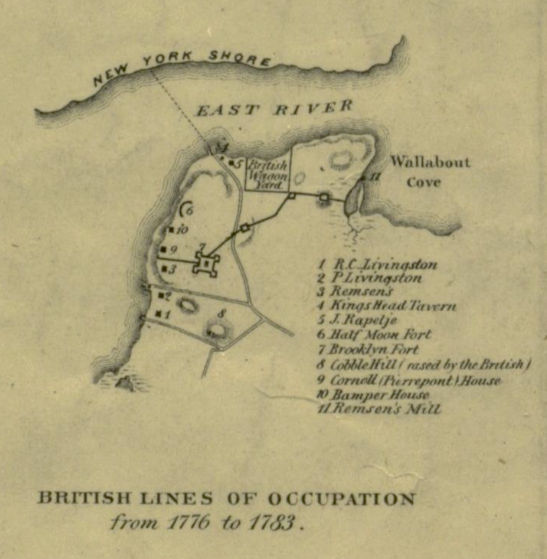
Livingston came from one of colonial New York’s wealthiest and most powerful families. His father was the second lord of Livingston Manor, a vast estate along the Hudson River, and Philip would go on to become a successful merchant and an important figure in New York politics. Although his primary residence was in New York City, Livingston also acquired a country estate across the East River in what is now Brooklyn Heights. The property included extensive gardens, and Garden Place, takes its name from the gardens that once occupied this part of the neighborhood.

As tensions with Great Britain intensified, Livingston became an increasingly important figure in the Patriot cause. He served as a delegate to the Continental Congress, but like many of his fellow delegates, independence was not initially the only possible outcome. In July 1775, after fighting had already begun at Lexington, Concord, and Bunker Hill, Livingston joined other members of Congress in signing the Olive Branch Petition. It represented one final attempt at reconciliation with Great Britain, affirming loyalty to King George III while asking the Crown to address the colonies’ grievances and prevent the conflict from escalating further.
That effort failed. King George III refused to receive the petition and soon issued a proclamation declaring the colonies to be in open rebellion.
Less than a year later, the possibility of reconciliation had largely disappeared. On July 4, 1776, the Continental Congress adopted the Declaration of Independence, and Philip Livingston became one of four delegates from New York to sign it.

Just weeks later, the Revolution arrived at Livingston’s doorstep.
In August 1776, a massive British force descended on New York. Livingston and other prominent Patriots were forced to leave, while Brooklyn became the site of the first major campaign following the Declaration of Independence. His properties would not escape the occupation that followed. Livingston's New York City residence was taken over by the British, while his Brooklyn estate was also commandeered during the occupation.
Livingston himself would never see the independence he had helped declare. He continued serving in the Continental Congress but died suddenly in York, Pennsylvania, in June 1778, while Congress was meeting there. He was just 62 years old, five years before the Treaty of Paris formally ended the war and recognized the United States as an independent nation.
The gardens and country estate that once stood here are long gone, but the name Garden Place remains, a small reminder of the Livingston family and of the landscape that existed here when Washington, the Continental Army, and the British descended on Brooklyn in the summer of 1776.
Come back tomorrow as we visit a Brooklyn fort built to stop the British invasion, and find out why it barely got the chance.


Comments