
Washington’s Retreat | Part 3 of 5: The View From Cobble Hill

Today, the corner of Atlantic Avenue and Court Street is dominated by a Trader Joe’s. But in 1776, you wouldn’t have recognized this intersection at all. Instead of busy streets and storefronts, you would have been standing near the base of a large hill crowned by one of the fortifications
protecting the American lines during the Battle of Brooklyn.

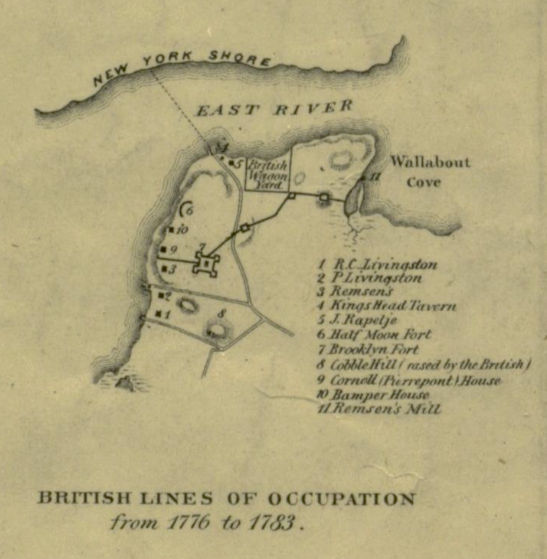
This was Cobble Hill Fort, sometimes referred to as Fort Corkscrew because of the trenches that reportedly spiraled their way up the hillside toward the fortifications at the top. The hill rose dramatically above the surrounding landscape, giving American officers a commanding view south and east across the countryside toward the Gowanus marshes and the battlefield beyond.
That elevation made Cobble Hill an important part of the American defensive line. In 1776, Brooklyn was still largely rural outside the small village clustered around the ferry landing. From the top of the hill, there were no apartment buildings, warehouses, or elevated highways blocking the view. An officer standing here could look out across farms, fields, roads, mills, and marshland stretching toward the wooded heights farther east.
And on August 27, 1776, that view would have revealed a disaster unfolding.

The British had outmaneuvered the Americans overnight, sending thousands of troops around the poorly guarded Jamaica Pass and crashing into the American left flank. As the Continental Army collapsed back toward its fortified lines in Brooklyn Heights, another American force under Lord Stirling found itself in danger of being trapped near the Gowanus.
Their escape route led across the marshes and waters of Gowanus Creek. To buy time for the rest of Stirling’s men to get away, a small force of Maryland troops under Major Mordecai Gist repeatedly attacked a much larger British force positioned around the Vechte-Cortelyou House — the building we know today as the Old Stone House.

These soldiers would become famous as the Maryland 400. Facing overwhelming odds, they charged again and again, holding the British long enough for many of their fellow soldiers to escape across the Gowanus.
Washington reportedly watched the fighting from the American defenses on Cobble Hill. Seeing the Marylanders being cut down as they tried to save the rest of the army, he is said to have exclaimed:
“Good God! What brave fellows I must this day lose!”
The Marylanders suffered devastating losses, but their sacrifice helped prevent an already disastrous American defeat from becoming even worse. The survivors of Stirling’s command made their way back toward the fortified American position in Brooklyn Heights, where Washington now faced an even bigger problem.
His army was trapped.
The British were closing in from the land. The Royal Navy controlled the waters around New York. Behind Washington was the East River and, beyond it, Manhattan.
The British thought they had Washington trapped. Tomorrow, we head to the Four Chimneys House, where he made the decision that may have saved the Revolution.


Comments